Concept 4
Circular Flow of the Economy
Businesses and households are allies and adversaries at once. A simple model of how products, factors and money move between them.
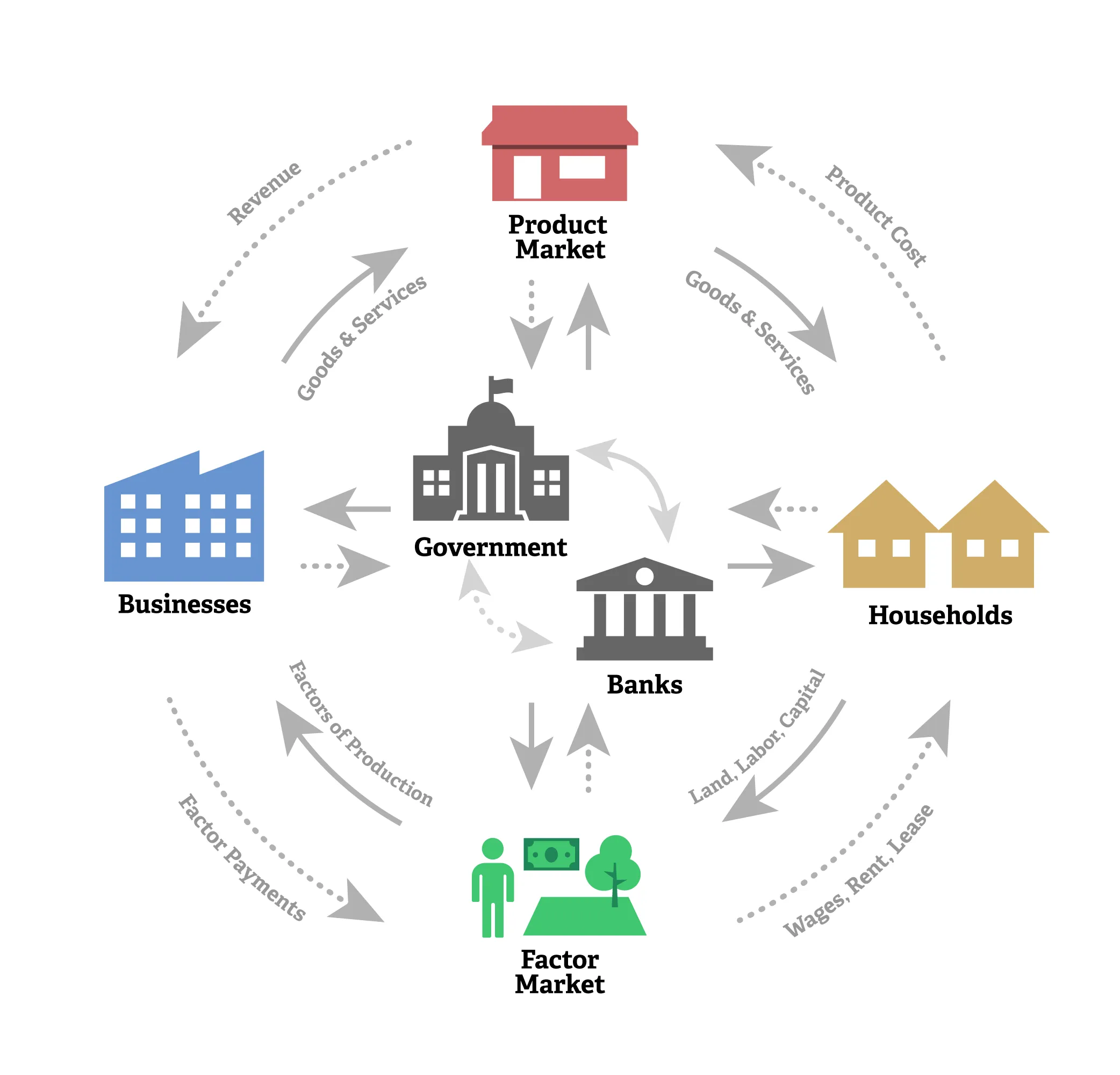
In looking at how economics work, it is often best to represent these large concepts by building models. Think about why models exist. They represent some reality that is far too large to look at in the current circumstances, and so a model is developed that will make it easier to understand. Models simplify complex ideas.
Additionally, there is a large role of assumptions in models. If you look at a toy model representation of a car, you know that it does not work like a car. Nonetheless, it helps you describe how the car works. Just looking at the model gives a clear representation of the actual item in discussion, in this case a car. If you were to encounter a person that had never previously seen a car, it would be far easier to give them a model of a car to explain its function than to give a detailed explanation. Assuredly, aspects of the concept would get lost in the in explanation regardless of how masterfully the description is delivered. This is why models are valuable in economics. They nicely summary exceptionally complex concepts.
Lesson 1 talked about the interactions between the household and business entities. Those interactions involving the factors of production are fairly complex, and as a result there is a model that simplifies the interactions of those two entities. The model that represents the interactions between individuals and businesses is called the circular flow of the economy. For this model, we are going to change the word individual to the word households. The word households is a better representation of the units that are counter to businesses in the economy. When making economic decisions, we as individuals do so with our overall household in mind, not just ourselves.
In the world of economics, businesses and households have a complex relationship that exists at multiple levels. On one level, the two are close allies. However, at another level, the two are constantly at war with each other. But even though they are at war with each other, they are intimately tied together in a symbiosis that will not let either prosper or survive without the other. The relationship between both is simultaneously adversarial and beneficial because of these multiple levels of interaction. Both are looking out for their own best interest on one hand, but both live for each other on the other hand. Each entity does have a single primary goal that is relevant to them.
-
Businesses strive to maximize profit. This means that they want to make as much money as possible. To do this, they should strive to provide the lowest quality product possible at the highest price possible. This does not mean that they want to cheat the other entity, it just means they need to produce as efficiently as possible.
-
Households strive to maximize utility. This means that they want to get as much satisfaction as possible from the products that they consume. To do this, they should strive to purchase the highest quality product possible at the lowest price possible. This does not mean that they want to cheat the other entity, it just means they want to acquire product as efficiently as possible.
So, it is easy to see why these two entities naturally agitate each other. Yet, they cannot survive without the other. Tying these two entities are other entities called markets. Markets are intermediaries that bring the two entities together in a naturally well-organized manner. They are vehicles used to bring buyers and sellers together to communicate and complete their interactions. Buyers and sellers agree on price and quantity in the markets. And both households and businesses are at times buyers and sellers, depending on which market one observes.
The markets are the battleground for the economic war between the entities. The market is where the buyers and sellers come together to agree on price and quantity. The two must negotiate a truce in the markets for the survival of all parties.
In the model depicted, it is easy to see how the businesses and households connect to the markets. The lines connecting each entity together are comprised of products and money. Product markets facilitate the movement of products in the form of goods and services to the households. Product markets facilitate the movement of product from businesses to households. These are often referred to as the output market for goods and services. These take forms, but ultimately are the most efficient way for businesses to get goods and services to the households. In return for acquiring product, households send money back through the model to the businesses to pay for their product.
Factor markets are on the opposite end of the model from product markets and facilitate the movement of factors of production in the form of land, labor, capital, technology, and entrepreneurship to the businesses. These are the input markets because they facilitate the movement of factors of production, key inputs for businesses, from households to businesses. In return, businesses send money back through the factor market to business as things like rent and wages.
In this model, every dollar ultimately makes its way through the economy from the households, to the markets and business, and then back to the households. This process works so well because of scarcity, the need for each to protect its own interests, and each maximizing their own interests.
There are two other entities that sit within the Circular Flow. Those are government and banks. Government and banks touch all of these other entities in the circular flow, including the factor and product markets. These entities do not exist in a primitive pure market-driven economy, but they do represent the realities of a modern market where both the government and banking are integral components of a functioning market. All aspects of today’s markets globally involve these entities.
As an example, government touches the businesses by regulating the safety of products, it may mandate what individual product markets can sell, it may tax products when sold to the households, and it may regulate how product flows through the factor market.
Banks, on the other hand, can make money available to businesses for expansion, they process the credit card transactions at the factor market, they act as a safe storehouse of money for households, and they are intricately involved in the flow of money for transactions of property in the factor market.
Obviously neither of these examples is all inclusive of the activity of the government and banks in the circular flow. The reach of both is mutli-faceted and multi-tiered. But this gives one example of the activity of both in the circular flow of the economy.